

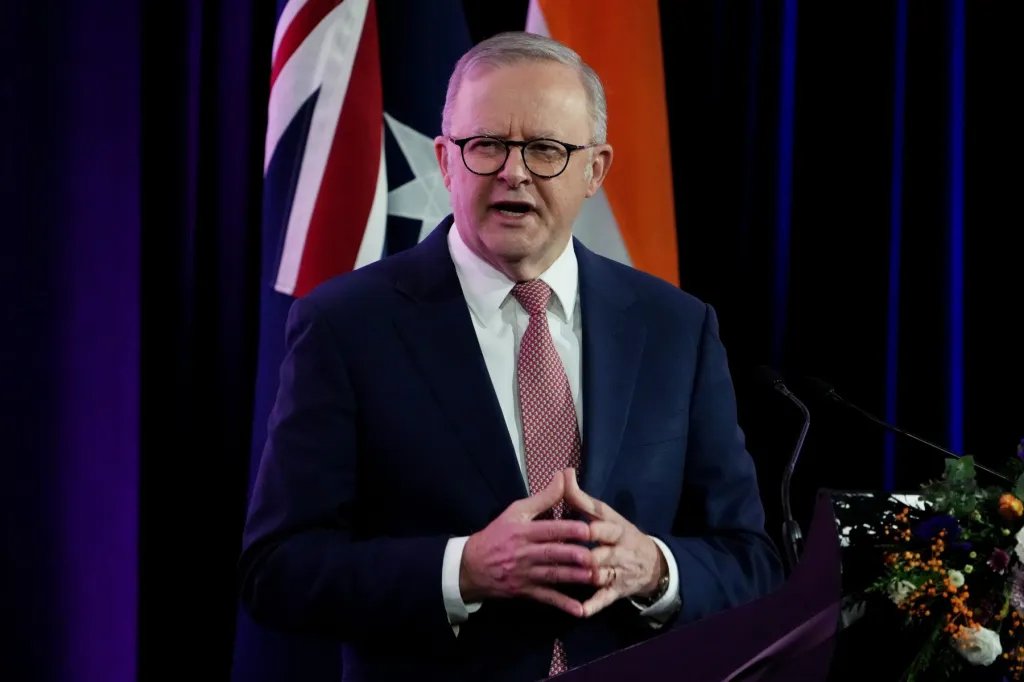

SYDNEY, Australia — A nervous music community was put at ease Wednesday, July 15 when prime minister Anthony Albanese removed any doubt that creatives would maintain control, and the value, for their work in the age of artificial intelligence.
During an address on AI at the University of Sydney, the nation’s leader gave the strongest of assurances that tech companies would not have the right to copyright-protected content, including music, to train AI “without the artist’s control.”
“Australian writers, musicians, artists and journalists must retain ownership and control of their work,” he remarked. “Our laws will spell that out plain as day. An artist’s creative endeavor is their work and their property.”
No company “should use Australian books, music, art or news to build or train AI without the artist’s control, and that includes the artist’s control of the price and value of their work,” he said.
Australia, Albanese suggests, has the opportunity to take the lead on this hot button topic.
“Nowhere do artists or rights holders have sufficient control of their work when it comes to AI training,” he added. “And that is why the best way to secure the strongest copyright protections for Australian artists is for Australia to be active and involved.”
Also during his speech, titled “AI in Australia’s interests,” the PM unveiled a new Office of AI which, with effect from today, would design the new Australian standards — essentially a functioning licensing framework built on consent and payment.
With those words, the domestic music industry, which has lobbied tirelessly on the protection of copyrights, breathed a collective sigh of relief.
“The prime minister could not have been clearer: Australian writers and musicians keep ownership and control of their work. Artists control what that work is worth, not the government and not a technology company,” remarks ARIA CEO Annabelle Herd.
“Control of price, value and terms of use are what underpin a commercial licensing market,” Herd adds. “The artist decides what their work is worth and who may use it. That is how licensing works everywhere else in the world and it is how it should work here. In the prime minister’s words: anything less is theft.”
The message to AI businesses “is clear,” she continued. “Now is the time to get on with licensing. Right now deals are being signed across music, journalism and publishing around the world. Australia’s creative industries are ready do business.”
Rights organization APRA AMCOS echoed those comments, and applauded Albanese for his “clear and unequivocal support for Australia’s artists, creators and copyright holders.”
“The prime minister has made it clear,” says APRA AMCOS CEO Dean Ormston. “The future of AI development in Australia must respect creator rights, that permission and payment must be sought, and crucially, the creative economy must benefit from AI innovation and development in Australia.”
APRA AMCOS has put a price on what a copyright carve-out would mean to the music space. The PRO’s landmark AI and Music Report found that, without a mandatory licensing framework, Australian and New Zealand songwriters and composers face a 23 per cent hit to their revenues. The bottom line: Australian and New Zealand creators would miss out on more than A$500 million ($350 million) over just four years.
Albanese’s comments on AI and copyright follow the Attorney General’s confirmation late last year that there would no copyright exception for AI training. Then, in December, the publication of the Productivity Commission’s final report on Harnessing data and digital technology, which concluded that it would be “premature to make changes to Australia’s copyright laws.”
Now, more than half a year on, the prime minister has given his word on the matter.
Damian Rinaldi, CEO of AMPAL, the music publishers’ association, welcomes the PM’s “unequivocal recognition that ‘an artist’s creative endeavor is their work and property’, and that Australian creators and rightsholders must retain ownership and control of their work, including its price and value.” And his declaration that “anything less is theft” sends a “powerful and unambiguous message,” Rinaldi continues. “Permission must come first.”
Maggie Collins, executive director of the Association of Artist Managers (AAM) was among the many industry leaders who made a submission to the National Cultural Policy, and was anxiously awaiting the outcome of today’s presentation.
“Australia knows its worth, and today’s speech by prime minister Albanese on the future of AI in this country made that crystal clear, when he articulated without a shadow of a doubt, that in embracing this new age,” she writes in a message to AAM’s members. “Australian writers, musicians, artists and journalists must retain ownership and control of their work.”
Read Albanese’s speech in full here.