


When Elizabeth Matthews thinks about the most unforgettable concerts of her life, her mind goes back to Ann Arbor, Mich., in February 1983, when her high school basketball coach scored free tickets for the whole team to see Prince on his 1999 tour.
But there was a catch.
“She agreed that we would all be the janitors after the show,” Matthews recalls. “We got to see Prince for free, and then we had to clean up the Crisler [Center] with our brooms.”
Matthews was happy to pitch in — and it proved to be an early sign of the work she’s willing to do behind the scenes for songwriters.
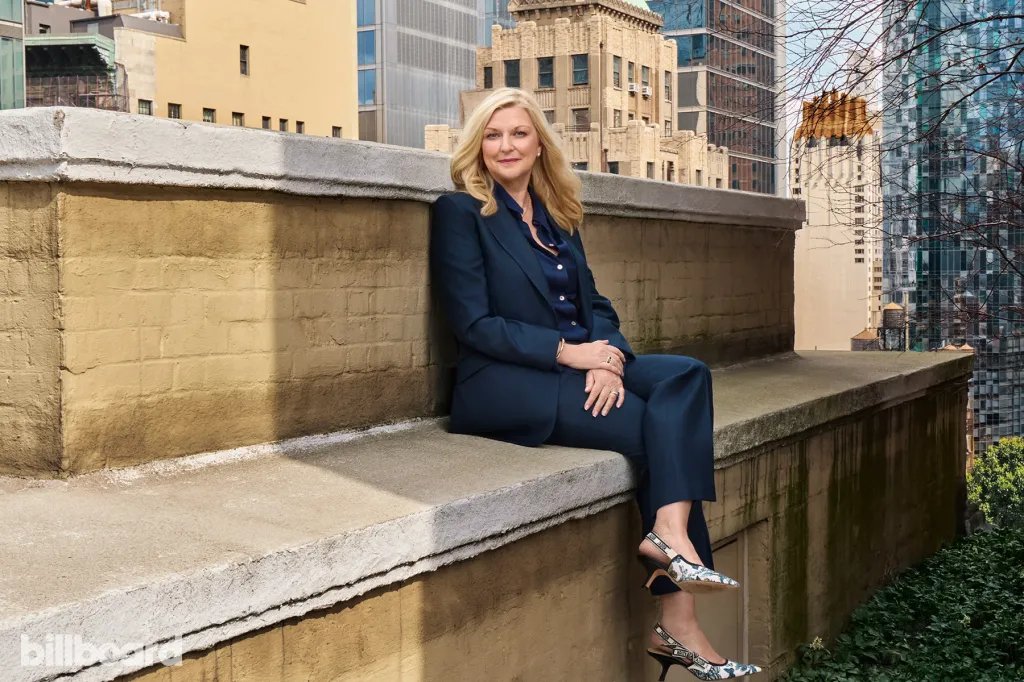
Since 2015, Matthews has led ASCAP, the performing rights organization that licenses, collects fees, tracks and distributes royalties for songs played on the radio or streamed online to its 1.1 million member songwriters, composers and publishers in the United States.
Founded 112 years ago, ASCAP is the only U.S. PRO that still operates on a not-for-profit basis, following BMI’s conversion to a for-profit company in 2023. ASCAP issues collective licenses, which allow businesses to play some 20 million songs written by legendary artists like Beyoncé, Jimi Hendrix, Mariah Carey, Neil Young, Paul McCartney, Philip Glass and Stevie Wonder; newer writers including KPop Demon Hunters’ EJAE, Lola Young, Chappell Roan, Noah Kahan and Amy Allen; and Latin music stars such as Marc Anthony, Daddy Yankee, Feid, Myke Towers, Romeo Santos, Becky G, Sebastián Yatra and Xavi.
“As an artist, songwriter and vocal producer, I really value organizations that support music creation and advocate for our rights,” says EJAE, who joined ASCAP in 2025, adding that she especially appreciates the support and resources it provides women and Asian music creators. “Beth and her team have been very supportive of me and the causes I care about. I appreciate their excitement about supporting songwriters of all genres and backgrounds, especially in an industry where Asian representation in songwriting isn’t always prevalent.”
ASCAP has no debt on its balance sheet, and its not-for-profit model translates to a payout ratio of around 90 cents per dollar collected, with the rest going to operating expenses. It is the highest among U.S. PROs, and, as ASCAP chairman/president Paul Williams puts it, makes Matthews “a greater expert on the care and feeding of music creators” than anyone else.
Under Matthews, ASCAP’s revenue and the royalties it distributes have risen to all-time highs. For the past 10 years, revenue grew by a compound annual growth rate of 6.7% and distributions rose by 7.3%. In 2025, that translated to $2 billion in revenue and $1.8 billion in royalties to members.
“What we do matters to more than a million people and their lives. If we screw this up, they can’t pay their bills,” Matthews says, speaking on a Friday afternoon in ASCAP’s Midtown Manhattan office. “We take quite seriously our obligation to work as hard as humanly possible to protect their rights, to advocate for them, to push on negotiations and licensing, to collect as fast as possible, to match and process as fast as possible and to get people paid. Because on the ground, it’s about paying the rent and buying food and paying tuition.”
David Needleman
That concern stems, in part, from Matthews’ recognition of the precarious future songwriters face. AI poses a threat to the job security of nearly all composers, lyricists and songwriters. Leading tech executives have called for the wholesale elimination of copyrights, and at least one head of a major music company (Warner Music Group’s Robert Kyncl) recently told investors it is working to find ways to bypass ASCAP and BMI to increase the portion of its digital music publishing rights that it directly licenses.
Amid ongoing uncertainty about the copyrightability of AI music and legal battles between major music companies and the leading AI music platform, Suno, Matthews has emerged as a leading advocate in music seeking to shape federal policy around generative AI.
She is a self-described pessimist, but she’s not a catastrophizer. Matthews acknowledges that it’s a hard time to be a musician — but says it’s always been hard. Her friends and colleagues say she barely sleeps, but not because she’s an insomniac: The tall, athletic, blue-eyed blonde with teenage daughters is a voracious reader. She is up at odd hours because she is reading up on the oil markets — during the week in March when Billboard interviews her — and gaming out risk scenarios to predict and forestall the worst possible outcomes.
“If you have gone through scenario planning, mapping from the worst- to best-case scenarios, you get a sense of control,” Matthews says. “If you’ve already envisioned the entire East Coast grid going down, you’ve already walked through ‘How quickly could we get people paid?’ It gives me a greater sense of calm and control because I’ve already gone through the psychological exercise. I don’t like surprises.”
Matthews’ friend and fellow ASCAP board member Michelle Lewis describes her preparation-oriented mind differently.
“In the zombie apocalypse, hopefully you’re with Beth,” says Lewis, executive director of Songwriters of North America (SONA). “She knows where the exits are, her phone is charged and she has good snacks. She’ll get you out of there alive, and it will be a little cushy, too.”
Matthews may now stand among the most powerful women in the music industry, but her path to the music world unfolded gradually.
She attended Purdue University in Indiana and later Emory University School of Law in Atlanta. Matthews graduated into the tech revolution of the 1990s, working in the technology business group at the white-shoe firm Milbank Tweed Hadley & McCloy (now Milbank LLP) and later joining the intellectual property and corporate law group at Chadbourne & Parks.
In 1998, she started at MTV Networks, eventually rising to the role of executive vp/deputy general counsel at Viacom Media Networks handling business and legal affairs for all commercial deals involving MTV, Comedy Central, VH1, Nickelodeon and other Viacom channels. Working alongside former MTV CEO Judy McGrath and former Viacom president Van Toffler, Matthews says the job was a “master class in … different types of [media] businesses and transactions.”
In 2013, Matthews joined ASCAP as general counsel/executive vp and was quickly named to replace John LoFrumento, who had led the organization for 17 years when he retired at the end of 2014.
She launched a strategic growth plan, a signature of her tenure that has roughly doubled ASCAP’s membership and revenue. She initiated a full-scale cloud migration for ASCAP’s back-end technology eight years ago, a move Matthews says was essential to “navigate the volume of performances that we have to ingest, process, match and pay out.”
“We were going from a couple of hundred million to trillions with a T,” Matthews recalls. “You have to get ahead of that curve, so your systems don’t break.”
David Needleman
Future-proofing ASCAP’s system was at the top of Matthews’ mind in February 2020, when, weeks before many Americans could envision the widespread COVID-19 closures that would become a way of life, ASCAP began doing work-from-home drills with its staff.
Matthews and key members across the organization instructed employees to take home laptops and other essential items on two different occasions in the month before March 12, 2020, when New York declared a state of emergency. Staff tell Billboard that preparation was key to ASCAP’s ability to operate without material interruption in the early months of the virus’ spread.
“When people practice and train for events, then it’s like muscle memory when they actually have to execute protocols,” Matthews says. “We see this time and time again in various contexts including security.”
ASCAP’s work with several hundred thousand licensees and international partner PROs processing payments, using internal proprietary systems and third-party platforms provided by Oracle, AWS and Salesforce, has forced it to adopt serious cybersecurity protocols. Speaking at the Mondo.NYC conference in October 2025, Matthews said ASCAP practices frequent “red team drills” where ex-governmental anti-cyber crime experts run them through hacking and ransomware emergency drills.
Other tech initiatives that Matthews has championed include ASCAP’s collaboration to strengthen Songview, a public online database of performance copyright ownership and administration shares, which ASCAP and BMI launched in 2020. Last September, SESAC and GMR (the invite-only PRO founded by Randy Grimmett and Irving Azoff) began sharing their catalogs and information with Songview to provide access to the ownership and administration data for more than 38 million songs.
One outside event that spurred GMR and SESAC to join Songview was the Notice of Inquiry (NOI) launched by the U.S. Copyright Office in February 2025 after congressional questions about new PROs, which it said lacked “transparency.”
ASCAP mobilized its membership to submit more than 4,600 letters to the Copyright Office in defense of the PRO system. ASCAP’s own letters to the Copyright Office stressed that the PRO market was healthy and competitive, and that a government-run version of Songview was not necessary.
The Copyright Office resolved the NOI around Thanksgiving in a letter in which it recommended no changes for ASCAP or other PROs and cautioned against further regulation, given that GMR and SESAC had agreed to join Songview.
Matthews leaned on her early career experience — when law was rapidly adapting to technology — again late last year when ASCAP joined BMI and SOCANin adopting policies to accept the registration of musical compositions that are partially generated with AI tools. In a joint announcement, the three PROs committed to continually reject fully AI-generated works, but said that musical works that fuse elements of AI-generated musical content with elements of human authorship deserve to earn royalties and be included in the repertoires licensed by each of the societies.
“You’re seeing the marketplace sort of crawl to a higher level of comfort with partially created AI works, because when you think about it, AI has been used for a very long time,” Matthews said at the Mondo.NYC conference just days after the policy was announced.
Internally, Matthews says ASCAP is examining how AI can improve its software development work, such as by writing code and eliminating duplicative tasks to free up staff “to work on more complicated endeavors to hit some of the challenges of scale.”
At any given time, ASCAP’s staff of several hundred is working on its “issues of scale,” and colleagues say it’s Matthews’ primary focus for the future.
“I have a theory that at the end of the day when Beth goes home and gets into bed, she glows in the dark for about four hours before her core cools off,” ASCAP’s Williams jokes.
Matthews’ team members says they’re comforted by their belief that the ASCAP CEO can see around corners. SONA’s Lewis, who is also a songwriter, says that style of optimism stemming from preparedness is exactly what the group needs.
“She is always considering all the angles,” Lewis says, noting the 4 a.m. text messages she occasionally receives from Matthews. “We have a leader who has really thought this through and knows that despite all of the obstacles we’re going to come out of this OK.”
This story appears in the April 18, 2026, issue of Billboard.