



This week, Billboard is publishing a series of lists and articles celebrating the music of 20 years ago. Our 2006 Week continues here with the Denver pop-rock band The Fray, who scored a pair of Billboard Hot 100 top 10 hits — “Over My Head” (No. 8) and “How to Save a Life” (No. 3) — that flexed the power of peak television.
Amid the 2006 domination of Southern hip-hop and R&B-rooted divas, two strains of comparatively melancholy pop cut through: sensitive white boys with guitars or pianos (Daniel Powter, James Blunt) and American rock bands (The All-American Rejects, Fall Out Boy). The Fray, a piano-driven Denver rock outfit, didn’t just sit at the intersection of those two strains — they leveraged the saccharine intimacy of those sounds into two of that year’s biggest and most enduring songs.
“It was just a different lifetime ago,” says former lead singer Isaac Slade with a twinge of awe. “Three eras have ended since then: living in Colorado, my marriage and my band. I didn’t have kids yet. I had hair! We were brimming with optimism and naivete, and that gave us reckless fearlessness because we didn’t know how far the fall could be.”
Like any storied band, lineup changes defined The Fray from the jump. The official debut lineup — lead vocalist and pianist Slade, bassist Joe King, lead guitarist Dave Welsh and drummer Ben Wysocki — emerged from the Denver church scene, where the members attended Christian school and helped lead worship. Around 2002, the lineup included Slade’s younger brother, Caleb, on bass. Caleb’s tenure was short-lived, and Isaac was the one burdened with breaking the news to him, which resulted in the final piece of inspiration for the song that would eventually become “Over My Head (Cable Car).”
For Slade, songs are often a smorgasbord of pivotal real-life encounters, divine inspiration and a plethora of mustard-seed-sized ideas stored in his brain and scribbled on scraps of paper. He used to tap the “Over My Head” drumbeat on his steering wheel to stay awake during his 3:00 a.m. drives working the opening shift at Starbucks and collected some of the lyrics in the first verse by eavesdropping on a customer’s conversation, jotting the words down on a pastry bag. Slade then set them to the drumbeat, which he played on his mother’s piano. Once he combined that beat with elements of the Charlie Brown theme song, he had the main riff (which The Chainsmokers would lift a decade later for the rollicking synth on their “Closer” hook). And then, as he tells it, a friend delivered the chorus lyrics (“With eight seconds left in overtime/ She’s on your mind, she’s on your mind”) to him in a dream, gifting him and King the final element of “Cable Car.”
Slade says it took a year and a half to finish “Over My Head,” a fitting timeline for a song that proved the solution to the band’s lengthy quest to crack the local radio scene. As the story goes, he got the band’s second EP in the hands of KTCL (93.3 FM) host Jeb “Nerf” Freedman by wielding his own one-man, Wayne’s World-esque “cable access TV show.” Nerf was the earliest music industry professional to bet on The Fray, slipping tracks from their EP onto the airwaves and offering the band production notes. Instead of re-recording an existing track to apply Nerf’s notes, the band sent him two demos — “Heaven Forbid” and “Over My Head” — that they raised $1,700 (by cleaning an office building) to record.
“There were probably eight songs prior to ‘Over My Head’ that we sent to little response,” reflects King. “We met at one of our parents’ houses and piled in the minivan because the home stereo was broken. We waited for an hour and a half for our song to play [during] the Sunday night locals’ hour, and the moment it came on was total euphoria. The next day, the station said they received a bunch of calls about the song; listeners in that moment responded to it, which convinced the station to put it in regular rotation.”
With a local hit thriving in power in rotation, The Fray closed 2004 by signing to Epic Records via A&R and producer Mike Flynn, as “Over My Head” continued its slow-burning journey to national hit status throughout the following year. In 2005, “Over My Head” appeared on the soundtrack to Rob Cohen’s 2005 sci-fi action flick Stealth — and though the movie was a critical bomb, it buoyed the song throughout the summer leading up to the September release of the band’s debut album, How To Save a Life. Peaking at No. 8 on the Billboard Hot 100, “Over My Head” wasn’t just a splashy debut single that rocketed The Fray to national notoriety — it also offered the band a blueprint for their follow-up smash.
“How to Save a Life,” the title track of The Fray’s debut album that eventually became the biggest song of their career, boasts multifaceted origins not unlike those of “Over My Head.” According to Slade, the song’s “five-year” process included a 1999 15-step resuscitation placard he spotted while in a swimming pool in England, a 2002 mentorship encounter with a recovering teenage heroin addict, and a high school-era argument with a friend that still carries heavy guilt.
Together, those three experiences coalesced into “How to Save a Life,” which Slade ultimately describes as a “fool’s errand.” “We set out to write the instruction manual on how to save somebody,” he says. “But there’s no one-size-fits-all approach.”
Slade broke down in tears twice trying to cut the lead vocal for “How to Save a Life”; his personal traumas bubbled up as he attempted to wade through the song’s innate tragedy. But as he listened to the playback he locked in after King consoled him, his vocal performance “took on [a feeling of] wisdom mixed with [resignation] that I was pretending to have,” Slade says. “I was writing an old-man song as a young man. I’m still in contact with that kid, and he’s doing amazing now, but my friend unfortunately passed away from alcohol abuse. It’s taken my whole life to feel like I can really fill that song out. I’m probably 10 years away from really being able to say it.”
While “Over My Head” always showed hit potential, “How to Save a Life” was a favorite of the band’s that seemed all but destined to remain a deep cut — until then-Sony Music CEO Don Ienner delivered his final notes on the album. Aaron Johnson, who co-produced the band’s debut LP, latched on to “Save” when it was just a mumble-ridden voice memo Slade showed him, but Ienner plainly said: “Album’s great, ‘Over My Head’ is the first single, re-record the drums and piano for track 12. That’s a smash.”
Gobsmacked that the big boss even cared to give their album a listen, the band found themselves battling between their indie inclinations and the idea of editing their art based on recommendations from label suits. Ultimately, their philosophy of “audience first, art second” triumphed.
“If I’m writing a song, it has to land for me to consider it successful,” says Slade. “So, we didn’t change the damn thing other than re-recording the original felt upright piano part on a grand piano and redoing the toweled drums on a big old rock kit.” (Just talking about the song’s evolution has the guys hankering to hear the original, with King adding, “It’s on a computer of ours that I was asking fans to help us hack into it because it wasn’t turning on. We may need to go to the Genius Bar!”)
Ienner always saw how far “Save” could go, but at the time of the album’s release, the band felt comfortable making it the title track because “it still played like a suicide prevention song and Stained and Nickelback were on the radio… it had been a minute since touchy-feely therapy music like [U2’s] ‘Beautiful Day.’” The Irish rock band’s 2004 LP, How to Dismantle an Atomic Bomb, also made The Fray feel more confident about a wordy album title.
“Over My Head” and the How to Save a Life album steadily grew throughout late 2005, but an impending multimedia tornado would take the Denver boys to even greater career heights by the spring of 2006. If film gave “Over My Head” a sizable boost, television vaulted “How to Save a Life” into rarified air. Grey’s Anatomy music supervisor Alexandra Patsavas used the song in a March 19, 2006, season two episode titled “Superstition,” which sent “Save” to the Hot 100 the following month. An instantly iconic marriage of popular music and contemporary television, Grey’s quickly secured “Save” as the official promotional song for the series’ third season, which began airing that fall.
“We liked our peers they were using, [like Snow Patrol], so it just felt safe in a way,” King says of the band’s decision to sign off on Grey’s using their song, with Slade adding, “Grey’s hit with that platinum plaque sitting on the wall already. We went double platinum in like, 60 days after that. 24 million viewership every week. Next thing you know, we’re everywhere.”
The band packed King’s house to watch the “Superstition” episode, and the “How to Save a Life” sync struck a chord with everyone in the room, whether or not they were familiar with the character and plot. Of course, it helps that Grey’s Anatomy was one of the biggest pieces of media on the planet in 2006: The show’s second season averaged 21.07 million weekly viewers, leading to its third season debuting with a whopping 25.41 million viewers. In a world before infinite streaming services and hyper-individualized algorithms, cable television was a near-unmatched steward of American monoculture. Throughout the 2006 television season, “How to Save a Life” also played in episodes of Cold Case, One Tree Hill, Conviction and Scrubs.
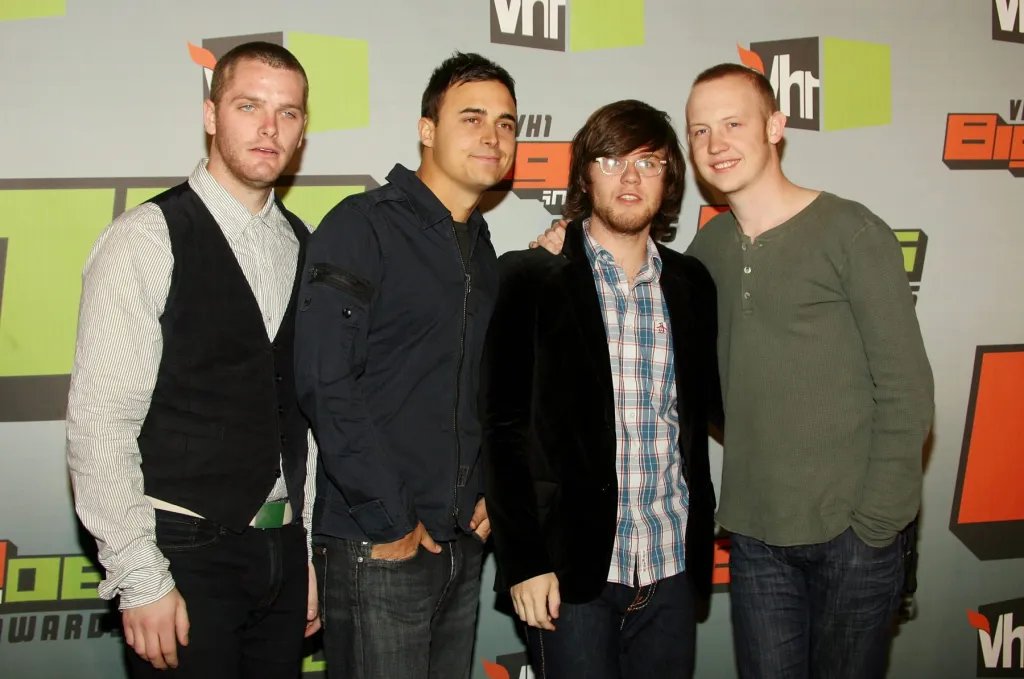
With two massive hits, one of which was tied to the buzziest television show of the time, The Fray suddenly found themselves rubbing shoulders with pop and rock superstars like Justin Timberlake and Bruce Springsteen. Even though they were still living in their parents’ basements, with the industry keeping them at arm’s length because they “weren’t cool,” The Fray ran into JT while backstage at the VH1 Big in ‘06 Awards.
“It was the first time we met Justin or interacted with him,” recalls Wysocki with a laugh. “His dressing room was near ours, and we were performing ‘How to Save a Life,’ so [Isaac] made a joke that [Timberlake] should come out and dance, and he pretended to be really offended that we thought all he did was dance.” Slade even remembers the Memphis star interjecting, “I play too! I can play guitar for you guys!”
Actually, Timberlake might not have been pretending. “He was offended,” King confirms. “I talked to him years later and he was not happy with us.”
As Denver “outliers” who defined style as “boot cut jeans and a G-Star jacket,” no gifting suite was safe from The Fray. “We took everything, and we didn’t know that they’d be taking photos of us, and we’d be brand ambassadors forever tied to them,” remembers King, who fondly recalls a pair of Juicy Couture sweatpants Wysocki snagged at one event. “Wasn’t that also the show where they gave away a black leather jacket, skinny tie and a white shirt, and we all wore it?” asks Welsh, with King gravely responding, “We all wore it in a picture with Bruce Springsteen.”
At the 2007 Grammys, The Fray nabbed nominations for both “Over My Head” (best pop performance by a duo or group with vocal) and “How to Save a Life” (best rock performance by a duo or group with vocal). Unfortunately, they lost both categories, which they found out in the most mid-’00s way: live on the red carpet via the late Joan Rivers.
For what it’s worth, The Fray lost both awards to fellow bands — a testament to how present groups were in mainstream music in 2006. The situation has gotten better in recent years with the Kpop Demon Hunters phenomenon, pop acts like KATSEYE and rock outfits like Sleep Token, but bands remain a rare sight on the Hot 100: Two years ago, Billboard reported that groups accounted for less than 8% of all Hot 100 top 10 singles since 2018.
“I miss bands,” adds King. “Maybe we live in an era that’s easier for one person to shine. And it’s really difficult to be and stay a band in general. Beyond that, a band is more expensive than just one person, so I’m cheering on any band out there. It’s depressing to look at the charts and rarely see bands on there.”
As bands claw their way back to Hot 100 prominence, The Fray can still hear their influence across Top 40 soloists — from Lana Del Rey’s painstakingly revelatory songwriting to the therapy-coded lyricism of recent albums from Ariana Grande and Hilary Duff and the “honesty” of songs like Billie Eilish’s “What Was I Made For?” In fact, you can draw a straight line between “How to Save a Life” and Logic’s 2017 Grammy-nominated suicide prevention anthem “1-800-273-8255,” which also hit No. 3 on the Hot 100. And that’s not to mention the “Cable Car” elements that helped make “Closer” the fourth-biggest Hot 100 song of the 2010s. “It’s like we were the embers, and they just built a fire on top of it,” says Slade. “It felt like a collaboration across time.”
20 years later, The Fray is still going strong. In March, they reunited for A Light That Waits, their first album in 11 years — and first since Slade left the band in 2022. The amicable exit led him to Washington state, where he currently resides and runs a record store. A week before he spoke with Billboard, Slade embarked on his first-ever solo tour, which he kicked off in Denver, just “21 minutes from the soccer field that The Fray played our first show in for my brother Caleb’s high school graduation 24 years ago,” he recalls.
Though The Fray’s paths have diverged in the two decades since their debut album catapulted four Denver homies to international stardom, the magnetic pull of songs that are no longer their own continues to keep them tethered.
“Our fans have taught us more about ourselves than we could have ever learned on our own,” says King. “These are all songs that we’re sharing in. We’re just lucky to be experiencing it together, and I hope we sing them for the rest of our lives.”