


This week, Billboard is publishing a series of lists and articles celebrating the music of 20 years ago. Our 2006 Week continues here with a look back at the brief (and possibly media-created) sensation that was the U.K.’s new rave movement, kicked off in ’06 with a pair of breakout singles from London dance-rock group Klaxons.
The 2008 BRIT Awards were something of a fever dream. For anyone who had spent the past two years living through the new rave era – a short-lived, chaotic fusion of electronica and indie-rock – it would have been vindicating to see Rihanna up on stage performing “Umbrella,” a global No. 1 smash, backed by Klaxons, the scene’s leading and most recognisable name. After all the jokes, the parties and glowsticks, the scrappy scene proved it could go toe-to-toe with pop megastars – before falling apart completely.
The seeds for this madness were sown in 2006. That was the year that the term new rave (or nu rave, as it was often styled) entered the British lexicon, and when bands like Klaxons, Late of The Pier and New Young Pony Club provided a garish alternative to Arctic Monkeys’ buttoned-down indie-rock. New rave shared many of the hallmarks of electroclash and dance-punk, two similarly frenetic and enlivening subgenres that had success on both sides of the Atlantic and throughout Europe.
In recent years, new rave has been one of the micro-genres swallowed up by the catch-all ‘indie sleaze’ label. The latter has been applied retroactively to a number of bands, artists and fashion styles that appeared in Lizzy Goodman’s totemic Meet Me in the Bathroom — an oral history of New York’s post-9/11 rock revival — and renewed interest in several of the acts. Though that book focused on the New York scene, British acts from the era were soon included into the “indie sleaze” aesthetic with Bloc Party, The Libertines and Franz Ferdinand among them.
New rave, however, provided an alternative to the trilby hats, leather jackets and winklepickers from acts looking to capture the same spirit as the post-punk bands of the late ‘70s and ‘80s. Instead they paid homage to the U.K. rave scene during 1989’s “Second Summer of Love,” and its attire was vibrant and a fusion of mid-00s high-street fashion (Topshop, H&M) with nods to ‘70s psych style. Glowsticks were worn as accessories. The more neon shades you could wear at once, the better. It was bold, silly and, according to the people who were there, barely even a scene at all.
Klaxons, formed by Jamie Reynolds, James Righton and Simon Taylor-Davis, were at the heart of it. The invention of the term was, in their own words, a ploy to give the music press a story to latch on to. “The whole idea of new rave was to take the piss out of the media by making them talk about something that didn’t exist, just for our own amusement,” founding member Reynolds told MTV.
But for journalists in the U.K., particularly at new music-focused weekly NME, it was an opportunity to create excitement for readers and bring together disparate artists, parties and characters into an umbrella term. A compelling narrative, particularly one that a title tries to own, is a shrewd way to shift magazines, however tenuous it may feel.
Speaking to Daniel Dylan Wray for his authoritative oral history in Vice, the paper’s former editor Connor McNicholas said: “People underestimate just how much the music press was driving forward these things. People always say to me I was incredibly lucky that there was so much going on during the time I was NME editor. And I’m like, “Are you f–king kidding me? We built that s–t.”
For Klaxons, 2006 was the start of their breakthrough moment. The group released their thundering debut single “Gravity’s Rainbow” in March 2006, which eventually landed at No. 35 on the U.K. Singles Chart, with follow-up “Atlantis to Interzone” (which the Billboard staff’s just named one of the year’s 100 best songs) arriving in June. Both were bombastic, intense and nailed the often-daunting task: a rock band matching the intensity of dance music. Following radio plays by influential DJs on British radio like Zane Lowe, Steve Lamacq and Jo Whiley, and the release of their Xan Valleys EP, the group landed a deal with Polydor Records.
In August the group played a fervent show at Reading & Leeds Festival, a rite of passage in the U.K. for post-exam students. It was music that felt thoroughly modern and fun and buzzed with electricity, and captured those who liked moshing to guitars, and those who wanted to drop a pill and cut some shapes on the dancefloor. Many soon graduated to Erol Alkan’s popular club night Trash, held in London from 1997 to 2007, which helped outsiders find a home and connect artists.
In late 2006, NME’s New Rave Revolution tour – a riff on the New Rock Revolution tag initially attributed to many of the acts featured in MMITB – starred Klaxons, Shitdisco and Datarock and took the sound to students across the U.K. Channel 4’s zeitgeisty teen drama Skins, which showcased scenes of debauched parties soundtracked to cutting-edge music, only added to the mystique and plausibility of the new rave title.
While those within the sub-genre bristled at the label, the fashion styles and inclusive spirit created a low barrier for entry. Alkan told Vice, “I try to think of what it’s like to be a kid in the middle of nowhere, reading about something and seeing there’s some kind of movement they can relate to. It can be exciting for people on the outside looking in.”
In January 2007, Klaxons released their debut album Myths of the Near Future which landed at No. 2 on the U.K.’s Official Albums Chart. The band’s profile in mainstream platforms was growing, and a year before their BRITs performance, saw them bring pop into their own world with a cover of Justin Timberlake and T.I.’s Billboard Hot 100 chart-topper “My Love.”
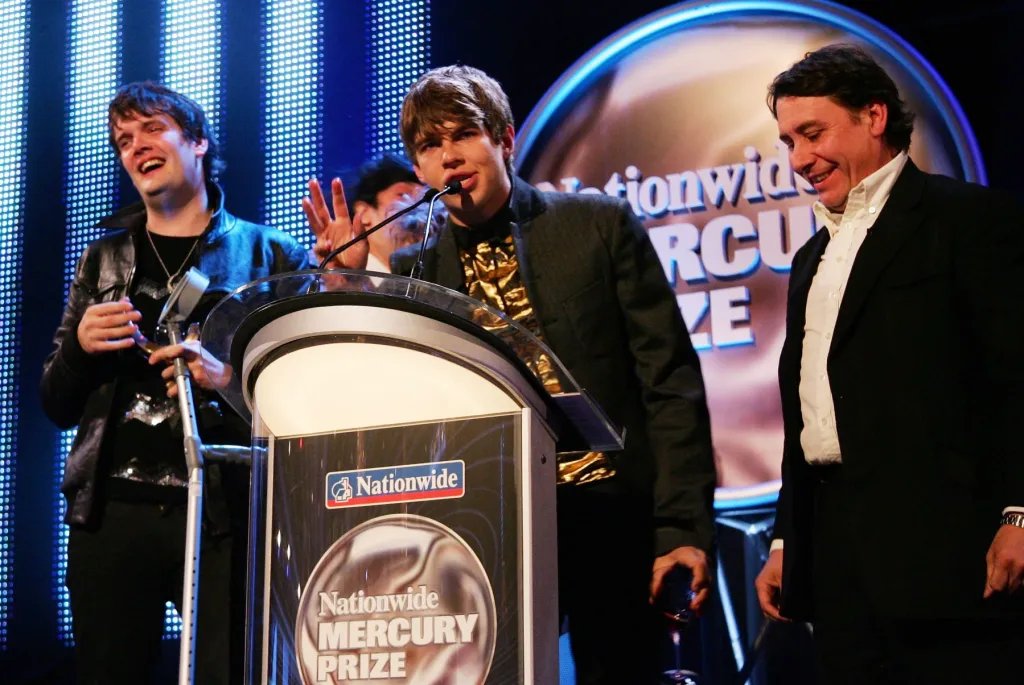
They would go on to win the U.K.’s acclaimed Mercury Prize in October of that year, but the group grew weary of their associations with the term. What started as an inside joke soon had been blown up and was outside of their control. In November, the group banned glowsticks from their show at London’s Brixton Academy and acts like CSS distanced themselves from the name, feeling that their work was being restricted. Journalists, too, turned on it quickly with The Guardian’s John Harris labelling acts like Klaxons and Shitdisco as “old rubbish.”
Like most underground music scenes, the end is swift. The genre’s defining throughline – party all the time – eventually had a detrimental effect. Drugs, predictably, played a role in the creative breakdown as did changing trends. After shifting over 350,000 copies of their debut, Klaxons’ 2010 follow-up Surfing the Void came too late and the dance scene had moved onto dubstep and EDM. Pointedly, the New Rave Revolution tour did not come around again in the following years and by February 2007, NME had already rebranded it to the Indie Rave tour.
Speaking to Loud & Quiet, Righton said that the new rave tag was a “death knell” from the start and they knew they couldn’t “ever live up to the level of expectation.” The group frittered away their label’s cash and several albums worth of material as their momentum stalled. The global financial crisis in 2008 brought in years of austerity in the U.K. and the relatively carefree moment of the mid-’00s felt abrupt. Singer-songwriters with sparse set-ups such as Ed Sheeran and James Blake felt more apt for the era.
By the time Klaxons hit the BRITs stage, the moment was already coming to an end. New rave’s legacy is confusing, disputed and loathed in equal-measure. But for a brief window, it was electrifying and unique for a new generation of music fans and even Rihanna. Speaking on BBC 6 Music, post-performance Rihanna called the collaboration and sound “really different, very cool, and unexpected.” We’re with you, RiRi.