



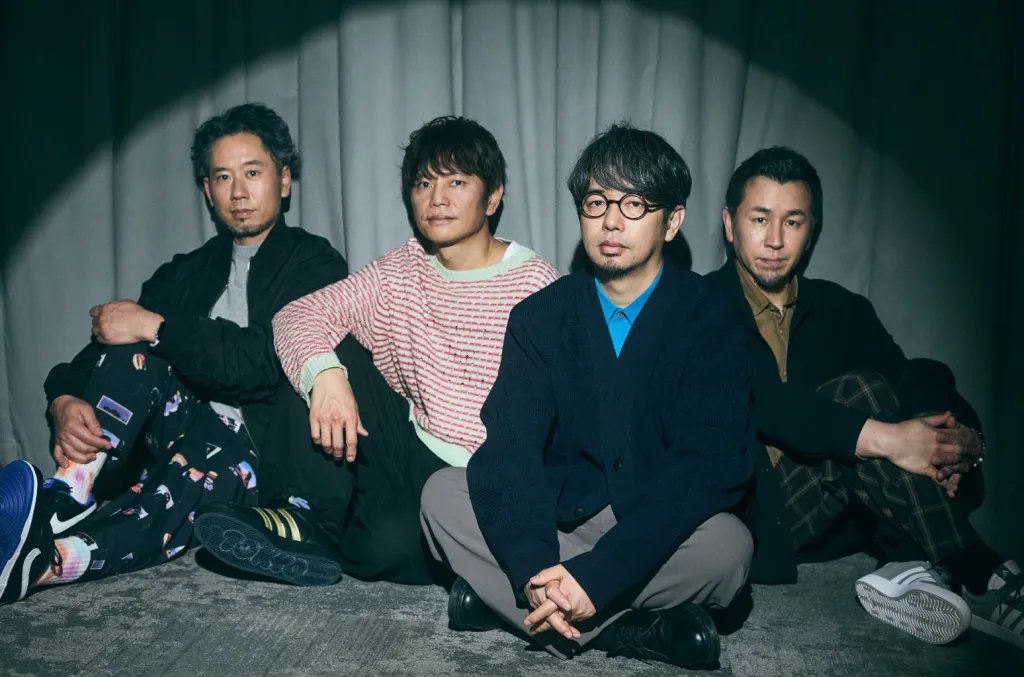

Japan’s ASIAN KUNG-FU GENERATION dropped Fujieda EP and new single “Skins” in back-to-back months. Recorded entirely at MUSIC inn Fujieda, a residential recording studio built inside a 130-year-old renovated storehouse, the four-track EP shifts texture from song to song while serving as a showcase for the quality of the Shizuoka facility.
“Skins” is the opening theme for the TV anime Dr. STONE: SCIENCE FUTURE Season 3. The song reworks the feeling of an age of wavering values into a common sensibility that can be shared across conflict and division. Billboard Japan spoke with all four members about the making of Fujieda EP, the perspective behind “Skins,” and their enthusiasm heading into their 30th anniversary overseas shows and Ariake Arena concert.
Fujieda EP was recorded entirely at MUSIC inn Fujieda. How did this studio come to exist in the first place?
Masafumi Gotoh (frontman, guitar): When young musicians are based in Tokyo, especially in the urban center, studio costs can be prohibitively high. Some places are expensive and cramped at the same time, which is a tough situation. I wanted to create a more accessible space where people could really take their time making music, and that’s how MUSIC inn Fujieda came about. We used crowdfunding and a lot of people’s support to get it finished, but once you’re ready to actually run a studio, you need to do some test recordings. So I asked the other members of ASIAN KUNG-FU GENERATION to take on that role this time.
What was it like to actually use the studio?
Kensuke Kita (guitar, vocals): I’d seen photos of it before, but when I saw the real thing, the first thing that struck me was how thoroughly it had come together as a proper studio, beyond anything I’d imagined. It’s not enormous, but the high ceilings make it feel bigger than it is. Since we did our pre-production at our own studio beforehand, we were able to record the same songs under the same conditions and compare, which was great. The drum sound in particular was fantastic. I was impressed because it was clear they built the space with that sound in mind. The care that went into it really does come through in the audio.
Kiyoshi Ijichi (drums): It’s also impressive that a storehouse like this still exists in Fujieda. Renovation must cost more than clearing the land and building from scratch. We once went to RAK Studios in London to record. It’s a place that’s been around for decades, and Europe has that culture of looking after old buildings. In some places, renovation rather than demolition is actually required by law. That’s a wonderful thing, and it gives neighborhoods a cohesive beauty. I’d always envied that. Japan has its share of earthquakes, which sometimes makes rebuilding unavoidable. So something like this is all the more remarkable and it moved me.
Takahiro Yamada (bass, vocals): The materials used were wonderful as well — reclaimed wood from disaster sites, and the original storehouse floorboards repurposed as wall paneling. (The floor uses Noto hiba cypress, and the walls incorporate salvaged timber rescued from areas affected by the Noto earthquake.) The staff were warm and full of character, and the whole environment was so comfortable. Honestly, the feeling I’m left with is, thank you for letting us be the first ones to use it.
Your new single “Skins” was released in April as the opening theme for Dr. STONE: SCIENCE FUTURE Season 3. How did you go about reflecting the world of the series in the song?
Gotoh: This is actually a song I wrote quite a while ago. I believe it was after we put out “Life is Beautiful,” and I was in a headspace of feeling like the only thing worth writing was anti-war songs. I was asking myself how to write something that could push back against the way things were going. But simply shouting opposition to war doesn’t accomplish much. As I kept thinking it through, I arrived at the idea that maybe we all have no choice but to shed the things we’re carrying. What’s left once each of us has stripped everything away is our naked bodies, bare skin — just “skin.” That’s where the title “Skins” came from.
And Dr. STONE is a story about humanity starting over after being petrified. It’s an epic tale, but also carries something like a critique of the modern world. That’s where I felt the two could resonate with each other. Rather than writing something from scratch, this was more about finding where an existing song and a work of fiction overlapped.
I get a sense that your recent lyrics convey strong messages about connecting through music across conflict and division. After the recent lower house election, you mentioned the studio and said something along the lines of “it doesn’t matter what party anyone supports.” What are your thoughts on that now?
Gotoh: It’s pretty clear that the world is full of people with different positions. Even when they speak the same language, people have divided over nothing more than believing in different gods. It’s been like that throughout human history.
That’s true.
Gotoh: I don’t think music exists to highlight those differences. What I’ve come to believe is that music’s potential lies in showing us that even people who have nothing in common can end up in the same place, moving to the same sound or beat, and share a feeling of, “This is good.” That there’s something like a common feeling, not just difference. Music shouldn’t be a source of division.
One of the reasons music saved me is that it never told me I wasn’t allowed to listen. There might be communities where you feel out of place, but I have no real memory of being turned away. That’s what expression is at its core, I think — open to anyone.
Absolutely.
Gotoh: I want to keep making things like that, and keep writing down things we need to think about within them. But at the root of it is a feeling that music should be there so that everyone can confirm together that it’s OK to be here.
I also wanted to ask about opening for Oasis. What was that experience like?
Gotoh: Tokyo Dome is massive. It was our first time playing a dome as ASIAN KUNG-FU GENERATION. Honestly, the last time I was there was 30 years ago when I went to watch a Nippon-Ham versus Orix game because I wanted to see Ichiro. So the idea of performing at Tokyo Dome wasn’t something I’d ever pictured. I went in half-expecting the sound to be bad, [Laughs] but it was actually good. I noticed it again at the Oasis show — things have improved a lot lately. The speaker systems have really caught up with the venues.
I was genuinely nervous being on that stage. It all came together pretty quickly, too. But after 30 years as a band, I also felt like we couldn’t afford not to play well. It would have been tough if we’d been told to play for 50 minutes, but 30 minutes? We could handle that. Still, when it was over, my mouth was completely dry. Whether that was the air pressure, the nerves, the adrenaline — I’d have to do it again to know. [Laughs]
Yamada: I was nervous, of course, but the crowd was warm, and I think we were able to get through it feeling good rather than stiff. The feedback was positive too, so hopefully some of the people who saw us there also came to the Ariake Arena show in April (the 30th Anniversary Special Concert “Thirty Revolutions”). That would really mean a lot.
Gotoh: The best beer I had all last year was the one I drank right after we came off, standing in front of the first-base dugout.
Kita: You had such a great look on your face.
Ijichi: Before we went out, Gotch (Gotoh) hugged all of us for the first time ever. I was a little moved by that. We’d actually opened for Oasis once before, in Nagoya (SUMMER SONIC EVE in 2005 at the Nagoya Port Open-Air Park). That was a pretty rough crowd. [Laughs] We could feel the energy of “just bring out Oasis already” while we were playing, so I figured this one would be similarly unwelcoming and stepped onto the stage with that expectation.
Then the moment I hit the first beat of the drum intro, I thought, “Huh?” There was this huge cheer. And from there, people were singing along. I was like, “They actually know our songs!” I don’t know whether Oasis fans had come to know us over the years since Nagoya, or whether people who already knew us were just big Oasis fans too, but feeling like we were genuinely sharing a bill as equals made me really happy.
This year, you’ll be celebrating your 30th anniversary in Indonesia, Mexico, Chile, and Peru, along with the upcoming arena concert in Japan. To close, could each of you share a thought about what’s ahead and a message for readers?
Gotoh: The fans who listen to ASIAN KUNG-FU GENERATION in Japan are incredibly important to us, but there are also so many people listening to us all around the world. It’s one of the things driving this band right now. If people are calling us there, I want to go everywhere we can while we still can. And I want to make music and put on shows that are worthy of that feeling.
Kita: The fact that we’ve been able to keep this band going for 30 years is because there are people who keep showing up, and I’m truly grateful for that. I want to give them a show they’ll be glad they came to.
Ijichi: I want to play a range of songs, old and new, and really do them right. There will be people coming who are new to us, and people who have been with us for years, and I’d love for both groups to leave happy. When you’ve been at it for 30 years, you have an enormous number of songs, and narrowing it down to around 20-something is its own challenge. But I want to pick and play the ones that feel right for who we are now.
Yamada: I’m always aware that there are people out there waiting for us. Whether it’s the overseas shows or anything else, I want to live up to that expectation, and I’m going to think carefully about how to do that and play with everything I have.
—This interview by Takanori Kuroda first appeared on Billboard Japan