


What makes music streaming services distinct from one another? In the early years, the answer was easier. Back then, exclusive releases were common. Jay-Z, for example, made that a core reason to subscribe to Tidal. Apple Music had its own special drops, including Frank Ocean‘s Endless, the visual album he used as a smart tool to quickly fulfill his label contract before dropping the self-released Blonde, also on Apple Music, one day later.
After that, however, exclusive drops have largely ceased to exist, forcing top competitors like Spotify, Apple Music, Amazon Music and others to search for new differentiating factors. Spotify, for example, bolstered its service with valuable other offerings, like podcasts and audiobooks. It also launched a number of shareable music discovery concepts like Daylist, Wrapped and AI DJ. Apple Music expanded radio shows from personalities, like Zane Lowe. It also leaned into its standing as one of the world’s biggest technology and hardware companies to create features, like Spatial Audio, that encourages both a high quality streaming experience and a reason to try their myriad of headphone offerings.
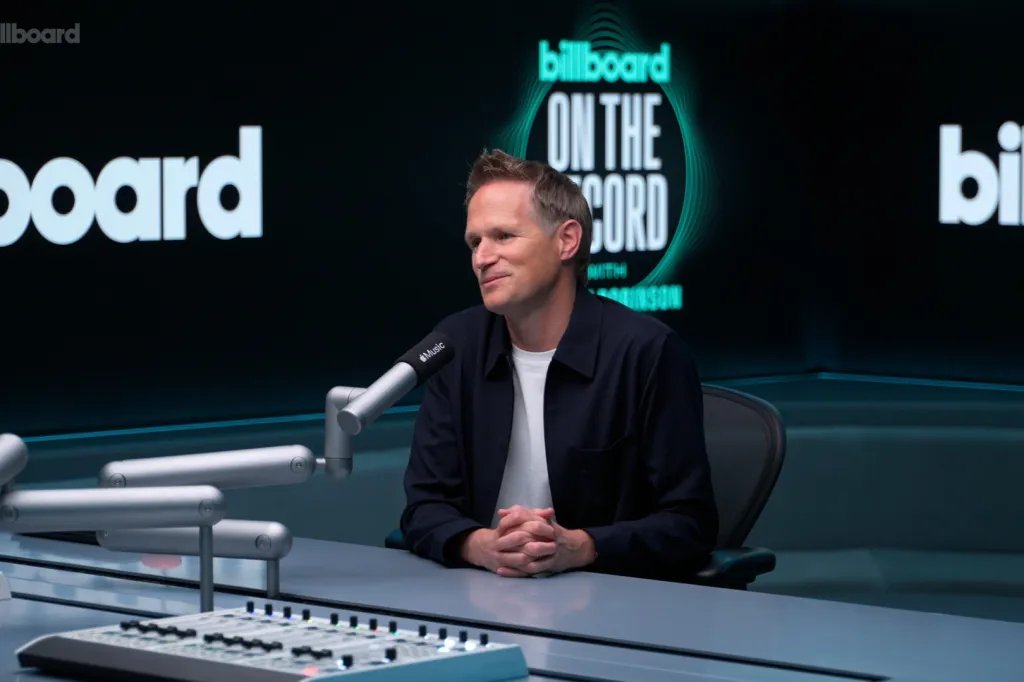
Still, it remains a never-ending challenge for music streamers to find ways to stand out from the pack. On this week’s episode of Billboard’s On the Record podcast, vp of Apple Music, Apple TV+, Sports and Beats Oliver Schusser joins to talk about why he thinks Apple Music is unlike any other service.
Watch or listen to the full episode of On the Record below on YouTube, or check it out on other podcast platforms here.
I want to talk about exclusives. That was once a differentiating factor in streaming, but it isn’t anymore — which is so fascinating to me. Back in the day Jay-Z was doing a lot of that with Tidal. Apple Music released Frank Ocean’s Endless visual album, and then 24 hours later he followed up with Blonde also on Apple Music —
Yes, the labels decided not to do exclusives anymore. The reason why I regret that, by the way, is because I think there’s a real danger that an album released these days isn’t as special anymore as it used to be. And you have a few artists like Taylor Swift or Harry Styles who can make it special because of who they are. But in general, I think the Friday new release day doesn’t really have the same magic [as] a new release day, I don’t know, 10 or 20 years ago. And I do actually think that when [streaming services] have something exclusively, they go the extra mile to shout from the rooftop on that particular release. But it is what it is. I can’t change it. There are a lot of things I don’t like in the industry that I can’t really change.
So, what’s another thing in the music industry that you don’t like?
I’m sure you’ve heard me say this: I think “free” was a terrible idea. Apple Music is the only service that doesn’t have a free tier, and believe it or not, we are really proud of that.
I do imagine that is tough for customer acquisition, especially in certain markets where there’s not a lot of consumer buying power, but tell me about your philosophy behind that.
First of all, we really look at music like art… We think when an artist spends nine months in a studio to make a piece of [incredible] work, no one in the world should think it’s okay to give that away for free. And if you look at — I don’t know if you watched [Severance], which was like, at the beginning of the year, the biggest and hottest TV show on the planet — the only way to watch [Severance] was, you have to sign up for Apple TV+. I mean, we have a free trial, so you can binge it in the first week, technically. But you can’t just go anywhere on the internet and consume all the shows for free. The same story, by the way, could apply to any Netflix or any Disney show. I think it’s not the right thing for songwriters and artists to just say, you know what, we’re going to give this away for free — especially with the very little monetization that artists and songwriters are going to get in return.
In case there’s someone listening who doesn’t understand this — for free tiers, it’s really an ad-supported tier actually. They do have royalty rates, but those rates are just much lower.
Yes, and it’s widely reported what the revenues are in that model. I think that’s the first problem. The second problem is more of a business problem, in my view: the fact that all paid services have to compete with free means, at the end of the day, not enough people are paying, because they can get it for free, and the paid services can’t actually charge the correct price for the service because they’re always competing with free…
Why do so many more people subscribe to a video streaming service than to a music streaming service?… Because you can’t get any of that content for free — they’re not competing with free. Video is not offered for free. In fact, when they have an ad [tier], they actually charge money for the ad [tier]. But music is odd, which — by the way, in the early days when we were coming off of file sharing and [Napster] was a hit, we were [building something new] — that might have been a good idea. But 15 years later, we still need to give away art for free. I think that’s a bad decision.
I feel like Apple Music is in an incredible position, though, because there are so many other facets to Apple. It gives you a lot of freedom to play with Apple Music. [A company like] Apple [can] afford to not have a free tier to their music service, but maybe something like a Spotify — that’s relying on streaming as its only source of income — can’t do that.
I don’t want to comment on any of our competitors, but if you look at them in aggregate, the monetization of [a] free service is so poor and so little. It’s not like it’s paying the bills for them. I would argue it’s the cheapest marketing mechanism in the world, where the labels have given everyone the right to basically do free marketing — like, take all our content and use it for marketing and then upsell.
How often do conversations about your hardware products [like AirPods] come into play when you’re developing new products at Apple Music [like high fidelity listening and Spatial Audio]?
To the consumer, the magic really happens when the hardware, the software, and services talk to each other and build groups of great experiences. And I actually think that spatial audio, and the work we did with Dolby Atmos, is almost one of the best examples of it.
If you look at audio, changing audio standards are hard. And if you look back over like 60 years, there’s only really been mono [and then eventually stereo]. [At Apple Music] we wanted to create a new standard with two distinctive criteria. One: we thought it’s important that people — general people, fans — can notice the difference. And number two: we wanted it to work on as many, if not all, devices. Not just Apple devices, but just in general. So, lots of people said lossless is the answer. I heard this from record labels: ‘You gotta do lossless.’ But what they didn’t notice is that lossless actually doesn’t work over Bluetooth. So, when you have a wireless connection, lossless doesn’t actually work. And in the days of AirPods and wireless headphones, the vast majority of people didn’t have wires. So there were lots of people out there not even noticing that.
I do agree that most average people can’t really hear the difference with lossless.
Correct. My second point is: honestly, if we did an anonymous [blind] test on just an iPhone with headphones — and you and I work in the industry, and I assume you like sound as much as I do — I can tell you most fans wouldn’t be able to tell the difference. But that’s what we did with spatial audio. And this required really a collaboration — not just [with Apple], but with lots of people. We worked with Dolby on creating [sound that comes] not from two sides, but really from everywhere. And it actually worked on pretty much all devices, all headphones, all of our [products], on iPhone, on Mac, but also on pretty much any other device. [There was] one downside: there were only roughly 5,000 songs in the world that had already been mixed and mastered in [spatial] audio. So, we [had] to go and upgrade all the studios in the world and also educate the sound engineers on what this new canvas looked like.
You recently released your first guidance as to how you would treat AI-generated music coming to Apple Music. Apple now allows labels and distributors to disclose AI use in songs. How much AI music are you really seeing?
When you look at our monthly intake, more than a third of what we get today is actually what we would say is 100% AI [music]. We have developed — and we’ve never talked about this — but we’ve developed technology in-house that would allow us to exactly see what music people are delivering us, what AI [model] it is and all that. That’s obviously important to know so you can analyze when something’s come in. Now, the reality is, the usage of the AI music on Apple Music is really tiny. I’m rounding but its below 0.5% of usage. We’re just at the beginning here. What is really tricky is when fraud comes to play. As I’ve said we are obsessed about the quality of the Apple Music experience. We have very high customer satisfaction. We’ve got the lowest churn in the industry. People that subscribe love the product, and we want to get rid of fraud.
How have you dealt with fraud so far?
This has been a 20-year journey because there was fraud, obviously, in iTunes already. We invest way more than anyone else in reducing and eliminating fraud… We implemented a fraud penalty four years ago where if we catch someone, then we actually take the money and put it back in the pool. We need to monitor AI music because there’s a correlation between AI and fraud. This is one of the reasons why we just doubled the fraud penalty for everyone this year. The good news is our fraud penalty works incredibly well. We’ve seen a 60% reduction sort of over time in fraud, just because of the penalty.
Do you have an issue with users uploading AI music in general on Apple Music, assuming it isn’t being fraudulently streamed?
I’ve said repeatedly to all the CEOs and presidents of the [music companies] there needs to be an industry consortium where they come together and discuss what is AI. And by the way, that can’t just be corporates. You need to have artists and songwriters in the room as well. Because there’s nothing wrong with artists and songwriters using AI even 100% but someone needs to then decide, well, what is AI? What’s not AI?
This is just an early step, but we’ve put it on the content providers, labels and distributors, to say, ‘hey, we want you to tell us when you’re using AI.’ We’ve created basically AI flags.
One thing I was concerned about when I saw that announcement was — doesn’t this just incentivize people to lie?
Well, first of all, you should know that every label in the world is delivering AI, [even if] they might not know about it. They themselves also need to develop tools to understand [the scope of AI use]… We have a bunch of other things we’re going to do over the course of the near future, but I really need the content providers and the labels to take responsibility.