


Over the years, Justin Bieber has become a Coachella regular, both as an attendee and surprise performer. At the fest’s 2024 edition, he popped out as a guest with Tems and Wizkid to perform their hit “Essence,” and in 2019 dropped in on Ariana Grande’s headlining set to perform “Sorry” and tease new music, telling the crowd he had to get his “swag back” (major spoiler alert for those who clocked it).
But tonight, the only person Bieber had to show up for was himself. And he did just that.
Leading up to his headlining set on Saturday night (April 11), the pop superstar delivered two intimate shows at famed West Hollywood venues, The Roxy and the Troubadour. Both sets were filled exclusively with SWAG and SWAG II tracks, not only helping Bieber get a feel for the new material live but also – and perhaps more importantly – bringing him back to the stage for the first time in four years.
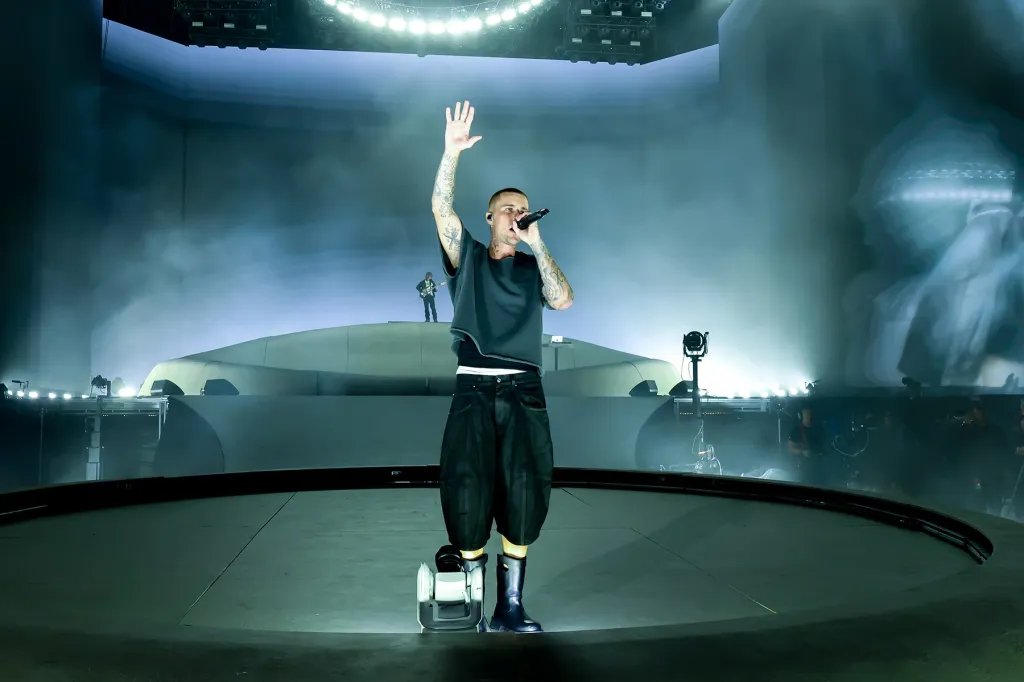
Now, the desert is a different type of stage entirely, especially compared to 500-capacity venues, but Bieber didn’t treat it as such. Instead, he managed to make a polo field of strangers feel like a late-night hang among close friends.
The set design was minimal, featuring only a fluid, cocoon-like structure on which Bieber could walk around, lay down and at times even shrink into — equal parts playground and safe space. His only prop: a laptop (but more on that later).
Bieber started strong with the boundary-setting “All I Can Take,” which also opens SWAG and serves the same purpose here: to remind himself and his fans that he will and always has given all that he can at any given moment. And it hasn’t been easy.
While Bieber openly chronicles such ups and downs across SWAG and SWAG II, hearing these albums live en masse crystallized their message. Together, they are a testament to his near two-decades of working out his identity, faith and purpose in the public eye. So much so that he spent the first 50 minutes of his set in the swagverse (save for a brief swerve into “Stay” featuring a surprise appearance from The Kid Laroi). Early set standouts included “Speed Demon” about keeping a tight inner circle and “getting better by the second” for it; “Go Baby,” his ode to wife and mogul Hailey Bieber; and “Walking Away,” his commitment to their family.
Next up: an acoustic portion, with Bieber seated in the center of an extended walkway accompanied by Carter Lang and Dylan Wiggins. The trio performed songs including “Glory Voice Memo,” “Zuma House” and an emotional and extended “Everything Hallelujah” with Bieber including the new line, “Coachalla, hallelujah.” (Tears coated his eyes when he sang, “Hailey, baby, hallelujah/ Baby Jack, hallelujah.”)
It was a quiet yet overwhelming moment of gratitude, and proved that Bieber’s biggest strength – in addition to being one of the greatest and perhaps most effortless vocalists of this generation – lies in those softer moments, when he wields his star power to make thousands of fans fall silent to hear his prayers.
“Tonight is such a special night,” Bieber said to the crowd, concluding the acoustic section. “But I feel like we gotta take you guys on a bit of a journey…” he continued. And oh baby, did he.
For the next 25 minutes, Bieber essentially embodied a millennial iPad kid – meaning, he sat at his laptop on YouTube. Before inevitably falling down an internet hole, pulling up once-viral clips such as “Deez Nuts” and “Double Rainbow” (you either know ‘em or you don’t), he dove into the archive. He played clip after clip of his greatest career-launching hits, singing along to snippets of “Baby, “That Should Be Me” and “Never Say Never,” among others, as their music videos filled the screen behind him. Lil Bieber then threw it all the way back to Baby Bieber, playing the video that launched his career: his famous “With You” cover.
It was a clever and authentic (albeit, time-consuming) way into his past, a reclaiming that celebrates the little kid he was while still aligning with the man he is today. Plus, it was perhaps the most efficient way to power through 12 songs that, truthfully, may have otherwise felt out of place in the set – even to those who don’t want to admit it.
But most of all, it was an oddly humanizing moment for someone of Bieber’s stature (especially when he pulled up clips of his younger self walking into a glass door or falling through a hole on stage). Underneath it all, there was an unspoken understanding of, “we’re good here” — like a long-awaited release. He revisited his roots, ran through the hits (including “Sorry” and “Where Are Ü Now) and poked fun at himself – like so many others have before. Only now, he’s in control – and owning it. Just look at his festival merchandise.
Is it clocking to you yet?
He filled his final moments with “Yukon,” “Devotion” featuring Dijon, “I Think You’re Special” with Tems (followed by “Essence,” for which Wizkid also joined) and finally, concluding with his latest hit, “Daisies,” spotlighting Mk.gee on guitar.
For fans, Bieberchella may have been a celebration of his career thus far. But for Bieber, it seemed to be more about celebrating his hard-earned and much-deserved peace — the reward at the end of a long road that has required Bieber to believe in himself every step of the way. Even, or perhaps especially, when others were quick to count him out.
And now, he’s made it perfectly clear that there’s nothing more important than protecting that peace — for himself, for his family and for his creativity. And that’s exactly the kind of business worth standing on.