



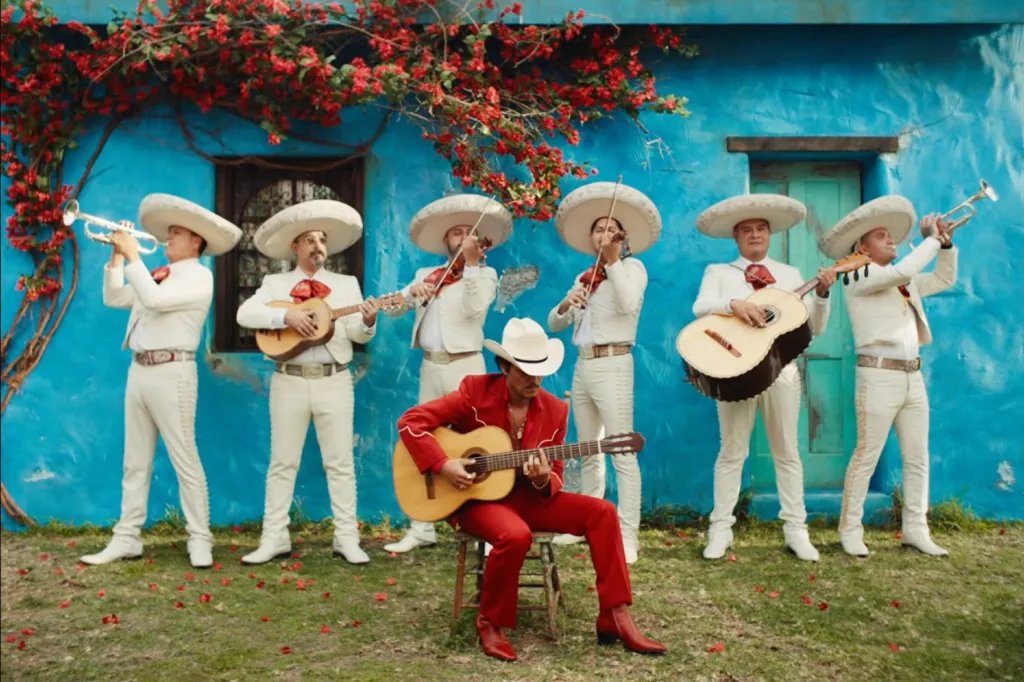

In the opening shot of the “Risk It All” music video, Bruno Mars sits poised, guitar in hand, dressed in a crimson matador-style suit and cowboy hat. Around him, L.A.-based Mariachi los Criollos de Guadalajara appear in crisp off-white charro suits complete with embroidered bow ties and wide-brimmed sombreros. Behind them, Guardian Angel Catholic Church in East Hollywood glows with worn blue plaster walls against the SoCal golden-hour sun.
The music matches the mood. Tenderly plucked nylon strings, and a sound that begins to swell: trumpets cry and violins hum with longing, all while Mars delivers crooning verses that lift the intensity further still. The bolero harkens back to love songs from a bygone era, but one kept alive by timeless tradition and passionate musicianship.
For Grammy-winning producer D’Mile, who co-produced Mars’ latest album, The Romantic, helping craft the opening bolero track wasn’t landing on a good version of the song — it was about finding the version. “Most of the time was spent figuring out what world we wanted to go to,” D’Mile tells Billboard Español. While Mars already had the title and a clear hook in mind, D’Mile says, “We tried so many different versions of that song.” The two-year process eventually led them to the lush, romantic bolero heard today.
D’Mile & Bruno Mars. Courtesy of D’Mile.
Released on Feb. 27, “Risk It All” has already captured hearts. This week, it debuted at No. 4 on the Billboard Hot 100, three spots behind The Romantic‘s lead single “I Just Might,” which tops the chart. Meanwhile, “Risk It All” landed at No. 1 on the Billboard Global 200 and the Streaming Songs list. He’s one of only two artists, alongside Kendrick Lamar, to simultaneously top the Hot 100 and Global 200 with separate tracks. The album also debuted atop the Billboard 200.
For an artist whose hits have leaned heavily into funk-pop anthems and retro-modern grooves, opening his first solo album in a decade with a bolero is an unexpected statement — but a fearless embrace of his cultural and artistic heritage. Mars was born in Honolulu, Hawaii to a Puerto Rican and Jewish father from Brooklyn and a Filipino mother.
At first, the team, along with Mars’ band the Hooligans, explored funkier, more uptempo directions, but nothing seemed to match the emotional power of Mars’ lyrics. “[We] just always just try a bunch of different ways to do it, until we land on something that just feels great to us,” D’Mile explains. “There was some funky versions, and one that felt like how [Romantic album-mate] ‘God Was Showing Off’ ended up feeling like. But then one day, [Bruno] was like, ‘I think the biggest mistake we’re making with that is that maybe it has to be a slow song.’ Most of the other versions were more up-tempo. And because of the lines that he was saying, ‘Say you want the moon, watch me learn to fly,’ maybe it shouldn’t be fun. It should be more romantic.”
That realization shifted everything. Mars and D’Mile decided to approach the song as a bolero, where its slower tempo, delicate guitar and lush instrumentation could amplify the romance at its core. D’Mile remembers the moment clearly: “I picked up the acoustic guitar and noodled around, and Bruno was freestyling and singing along. That started the whole idea, and we were like, ‘Okay, this is where we go.’”
“I was very much excited about that version more than any other version that we did,” he continues. “I don’t think I’ve heard him do anything quite like that, and I just remember telling him, ‘This one is great, because it’s different for you.’” It was a version that showcase Mars’ rare ability to innovate while exploring his roots — a delicate balance that redefined expectations for the album opener.
When it came time to translate the bolero into a music video, Mars recruited Mariachi Los Criollos de Guadalajara to bring an added layer of authentic elegance. Though the mariachi ensemble didn’t play on the official recording — Mars’ band, The Hooligans, handled the studio production — the group played a pivotal role in shaping the visuals that have already captivated nearly 34 millions of viewers on YouTube, since its’ two-week release. On Spotify, it’s already over 70 million streams.
Mariachi Los Criollos de Guadalajara was initially hired to appear in the video, performing to playback audio. “They hired us to pretend to play the instruments,” recalls the group’s bandleader Joel Jacques, but the band had other plans. “In the end, we learned the song by ear and actually played it. When [Bruno Mars] heard us, he said, ‘Wow. These are real musicians.’” Jacques adds that it’s not a good look to fake playing the music, hence learning the song immediately.
How the group landed the gig speaks to its professionalism and stature. “It was a casting,” Jacques explains, adding that their impressive online reputation, bolstered by their Yelp following of over 150 five-star reviews, helped them land the gig. To seal the deal, Jacques emphasized the importance of authenticity and tradition, sending videos of iconic artists like Elvis Presley performing “Guadalajara” with Mariachi Vargas de Tecalitlán — the gold standard of mariachi music. “I told them, ‘Look at Vicente Fernández or Juan Gabriel. None of them came out with small mariachis; there were always 10, 11 musicians. That’s how it should be,’” Jacques recalls. His insistence on grandeur resonated with the casting director.
“As representatives of our Mexican music, we have to always be impeccable,” Jacques says. Mars followed suit, delivering a visual and sonic tribute to mariachi elegance.
For Jacques, the rich, layered visuals of the music video mirror the multifaceted global legacy of mariachi, a tradition rooted in his native Guadalajara, one of the birthplaces of mariachi music. “Being from the land of mariachi means something. I was always taught to respect and wear the charro suit with pride,” Jacques says, reflecting on mentors like the late Lino Briseño, an original member of Mariachi Vargas, who instilled in him discipline and reverence for the craft.
While regional Mexican music has exploded internationally in recent years, Jacques acknowledges that norteñas and corridos tend to dominate the genre’s spotlight. Yet, he doesn’t see this collaboration as a departure from mariachi’s core — it’s simply another chapter. “Regional Mexican music is now categorized as norteño, banda — a whole bunch of things, but not mariachi,” he says, lamenting how the genre that forms “the foundation of all our Mexican music” is sometimes overlooked. For him, this bolero’s moment in the spotlight is a long-awaited opportunity to showcase the genre’s instrumental richness and romantic core. “It’s a fusion of huapangos, sones, guitarrón, vihuela, and harp. It’s something beautiful and full of feeling,” Jacques says.
That sentiment, Jacques adds, connects the music of Mexico and Puerto Rico. Songs like “En Mi Viejo San Juan” — originally by Puerto Rican composer Noel Estrada, but made iconic by Mexican mariachi legend Javier Solís — embody the bonds shared between the two traditions. “Puerto Rico and Mexico have always been twinned in musical matters,” Jacques explains, underscoring how bolero bridges their romantic legacies.
With a Puerto Rican father and a rich musical upbringing, Mars seemed to draw on those roots. For D’Mile, the themes of “Risk It All” may have acted as a bridge between Mars’ artistry and his cultural heritage.
“I feel like, yes,” D’Mile says when asked whether this song was a way for Mars to explore his roots. Though it was never explicitly discussed, D’Mile reflects, “Sometimes I do wonder the reasons for his choices. When you look back, it’s probably in the back of his mind — he was thinking, ‘Yeah, I do want to tap into that side of things.’ Because that’s what he grew up on. His father was a percussionist. His whole family, they were all into that side of things.”